
IDLab at the XII International Conference on Applied Research in Economics – iCare
October 30–31, 2025, researchers from 16 Russian and 9 foreign universities discussed the processes of internationalization in developing economies at the Perm campus of HSE University as part of the XII International Conference on Applied Research in Economics - iCare. Staff from the International Laboratory of Intangible-driven Economy also presented the results of research conducted within various projects. For more details, follow the link.
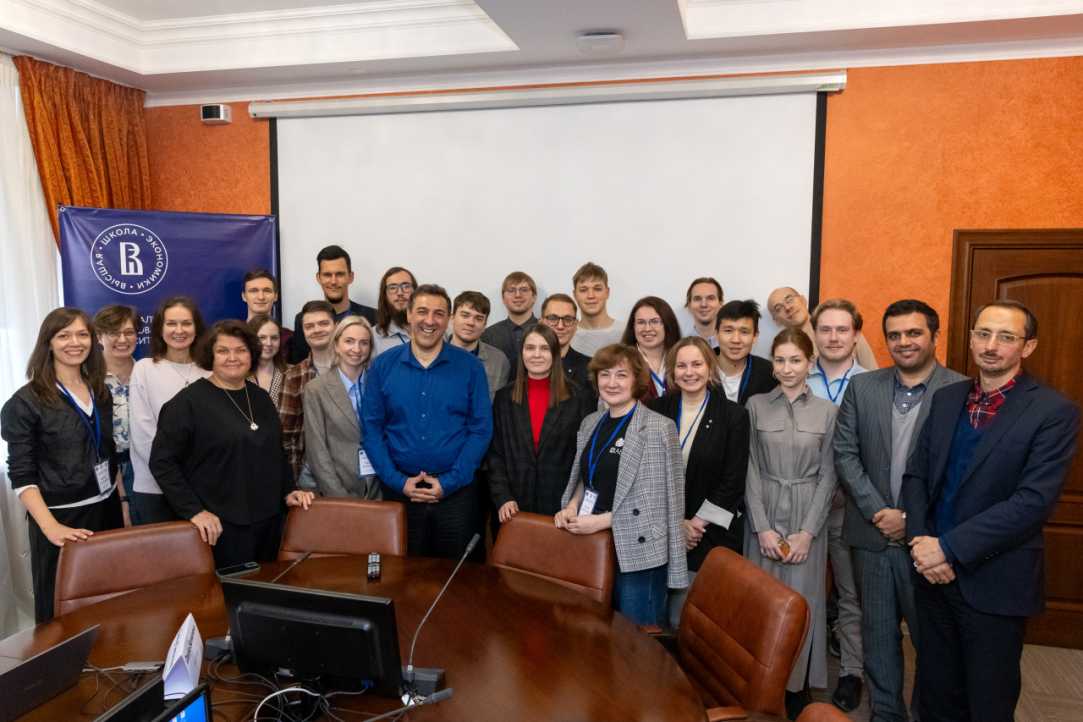
October 30–31, 2025, researchers from 16 Russian and 9 foreign universities discussed the processes of internationalization in developing economies at the Perm campus of HSE University as part of the XII International Conference on Applied Research in Economics - iCare. Staff from the International Laboratory of Intangible-driven Economy also presented the results of research conducted within various projects. For more details, follow the link.
As part of the HSE University Fundamental Research Program, Petr Parshakov presented the study “When Stakeholders Disagree: Using NLP to Map Intellectual Capital Disclosure in Divergent ESG Ratings”, co-authored with Yulia Naydenova, Sofia Paklina, and Elena Rapoport.

Исследование посвящёно тому, как компании реагируют на расхождение ESG-рейтингов между различными агентствами. В работе показано, что противоречивые оценки создают неопределённость для инвесторов, и в ответ на это фирмы усиливают раскрытие интеллектуального капитала - человеческого, структурного и отношенческого. Исследование, основанное на NLP-классификации текстов ESG-отчётов и эконометрическом анализе, демонстрирует, что интеллектуальный капитал помогает компаниям поддерживать доверие и стабильность показателей в условиях разнородных ESG-сигналов.
Within the framework of the HSE University project "International Academic Cooperation," the following research was presented:
- Dmitry Kashin - “Regional IC-driven Internationalization”, the study is devoted to analyzing the influence of intellectual capital (IC) in Russian regions on their export activity. Using panel data for 2000–2023, the researchers empirically revealed a non-linear S-shaped relationship between the intellectual capital index and regional exports. The research also confirmed that intellectual capital is a stabilizing factor, increasing the resilience of regional exports to external shocks.
- Anna Daviy, jointly with Maria Molodchik and Elena Rapoport, presented the study “Local or Global? Strategic IT Vendor Selection and Firm Performance”. The research analyzes how the choice between a local and a foreign IT solution vendor influences the effectiveness of a company's digital transformation. The authors demonstrate that this strategic choice is not a purely technical decision but a complex managerial, and sometimes compromising, decision between access to advanced technologies and dependence on external suppliers. Using unique data spanning a 20-year period, the study shows that local vendors often provide better results due to their deep understanding of the local business environment, cultural compatibility, and support flexibility.
- Egor Nazarovsky, jointly with Maxim Kataev and Maria Molodchik, presented the study “The influence of intellectual capital on the resilience of exporting companies under sanctions”. The research was aimed at assessing the influence of intellectual capital (IC) on the resilience of Russian exporting companies under sanctions. The results of the panel analysis show that intellectual capital has a significant positive impact on export revenue, however, the growth of administrative costs may weaken this effect.
- Dilmurod Tillashaykhov presented the study “Literature review on regional IC-driven internationalization”. The study involves a systematic literature review on regional internationalization through the lens of intellectual capital (IC): the authors collected a number of scientific publications and analyzed how the components of a region's intellectual capital (human, structural, and relational) influence its ability to enter foreign markets. The main research question is: How does a region's intellectual capital contribute to its internationalization through the development of service exports?
- Ekaterina Akhmetgalina, jointly with Marina Zavertiaeva, presented the study “The Impact of CEO Characteristics on Financial Resilience of Russian Exporting Companies”. The research aimed to identify the influence of the personal and professional characteristics of CEOs on the ability of Russian exporting companies to maintain financial resilience, including in conditions of market uncertainty.
The following research was presented as part of the RSF project "Professional Burnout Syndrome: Identification Using Artificial Intelligence Methods and Economic Impact Assessment":
- Grigory Teplykh — “Analysis of the Negative Impact of Occupational Burnout Risk on Human Capital in Russian Regions. The study aims to analyze the influence of increased working week duration, which is used as a measure of occupational burnout risk, on the quality of human capital at the level of Russian regions. Data spanning 2001–2023 for 87 Russian regions are utilized. The analysis employs a fixed-effects model estimated using the instrumental variables method (2SLS). The results indicated heterogeneous effects of high burnout risk on different types of morbidity (illness) and mortality.
- Nikita Matkin — “Google Search for Burnout and National Culture”, jointly with Evgenia Shenkman and Tatyana Permyakova. The research analyzes how residents of different countries search for information on professional burnout on Google and how these differences in search behavior are related to national cultural characteristics, showing varied dynamics depending on socio-economic factors.
- Daria Semenova — “Scale for teaching burnout: adaptation for Russian language”, jointly with Anna Provorova, Marina Zavertiaeva, and Tatyana Permyakova. The presentation focused on the adaptation of the English-language Teachers Burnout Scale (TBS) into Russian. This scale is a modern, specialized tool, but the lack of an adapted Russian version limits research and practical application opportunities in the Russian educational environment. The study involved the translation, adaptation, and testing of the psychometric properties of the Russian-language TBS for subsequent research and practical use.
- Nikita Matkin — “Happiness Emodities: Commodification and Marketing Strategies in Popular Psychology on Youtube”. The research revealed the mechanisms for the formation of the popular psychology market. Four dominant marketing strategies were identified that allow psychological issues (demand) to be quickly pinpointed and a corresponding diagnosis (supply) to be immediately offered.
- Alexey Smirnov — “Workplace Practices and Burnout Signals in Employee Reviews”, jointly with Sofia Paklina and Petr Parshakov. The presented research results were based on the analysis of over 1.4 million employee reviews. The report highlighted the key factors associated with reducing the likelihood of professional burnout, as well as the role of both financial and non-financial corporate practices in maintaining employee well-being.
As part of the RSF project "Comparative Analysis of AI-Based Agents and Real Individuals in Economic Decision-Making" (No. 25-18-00539), Sofia Paklina presented the paper “LLMs vs. Humans: Gender Differences in the Dictator Game” at the poster session, which was co-authored with Petr Parshakov, Evgenia Shenkman, and Nikita Matkin. The research tests whether Large Language Models (LLMs) are capable of reproducing gender differences known from classic behavioral experiments. A comparison of decisions in the Dictator Game shows that the models behave more generously than humans but nonetheless retain social asymmetries that depend on the model's architecture and the nature of its textual explanations.
Organizers: International Laboratory of Intangible-driven Economy, HSE University and Iran University of Science and Technology. The conference is held as part of the Joint Basic Research Program " International Academic cooperation".
